Identity, Power and the Year Between
A Healing Reflections Essay by Martyn Blacklock
(10–12 minutes)
We are living at a threshold. Not a dramatic breaking point, but something quieter and more exacting: a moment where the ways we have learned to organise power, identity, work, and meaning are no longer sufficient, yet what comes next has not fully arrived. These in-between spaces are uncomfortable. They resist certainty. They ask for attention rather than answers.
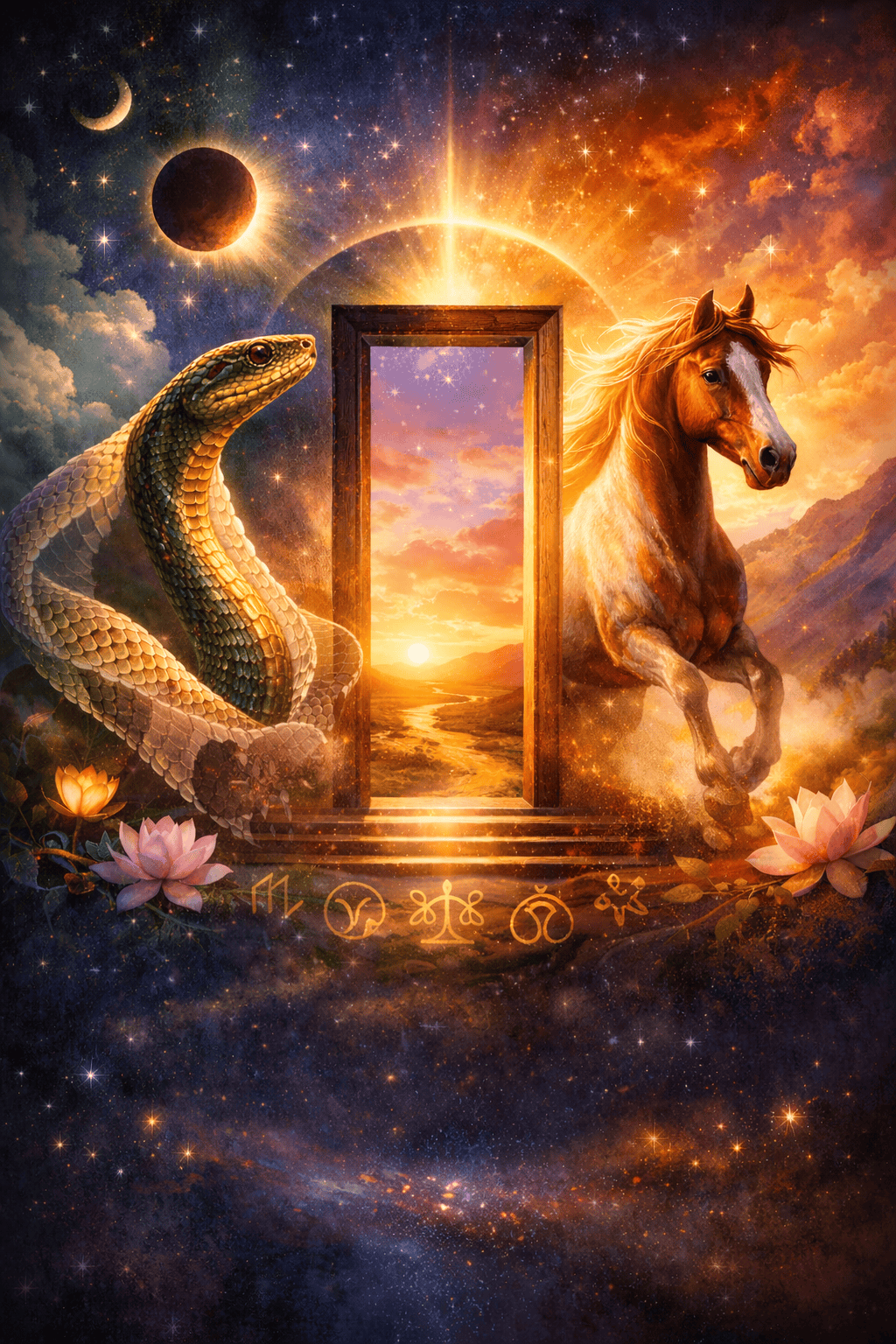
Astrologically and symbolically, the transition from the Year of the Snake into the Year of the Horse mirrors this moment precisely. The Snake is associated with shedding, discernment, and deep internal intelligence. It is not hurried. It works by sensing when a skin has become too tight to live in. The Horse, by contrast, brings movement, vitality, and outward expression — but only when the body is ready. The Horse does not drag old skins with it. It requires lightness.
In numerological terms, 2025 carries the energy of a 9 year — completion, integration, endings that cannot be postponed. 2026 begins a 1 year, an initiation. But initiations that come too early, without proper reckoning, tend to recreate the very systems they were meant to replace.
This essay is an attempt to stay with that reckoning.
1. The End of a Way of Organising the World
It is increasingly clear that the world as we have known it is not working. This is not a political statement so much as a human one. Systems organised around domination, extraction, certainty, and speed are showing their limits — relationally, ecologically, psychologically.
We see this in global politics, in economic instability, in the mental health crisis, in the polarisation of identity, and in the growing inability to listen across difference. When old structures begin to fail, they often respond by tightening. Control increases. Fear is mobilised. Certainty is weaponised.
Sonya Renee Taylor reminds us that many of these systems are built on a fundamental disconnection from the body — from vulnerability, from interdependence, from limits. In The Body Is Not an Apology, she writes that liberation is not an abstract concept but a relational practice rooted in recognising inherent worth. When systems lose sight of this, they collapse inward, attempting to preserve power rather than relationship.
Jane Goodall has spoken similarly about hope not as optimism, but as responsibility — something we practise through the choices we make when the future feels uncertain. The work, she suggests, is not to dominate,
the unknown, but to tend to what remains alive within it.
2. The Snake’s Work: Shedding Without Replacement
The Year of the Snake asks us to pause before rebuilding. It invites discernment rather than reaction. This is not a year for dramatic reinvention, but for honest inventory: What identities are complete? What roles have we outgrown? What ways of relating to power no longer reflect who we are becoming?
Elizabeth Gilbert often speaks about endings not as failures, but as moments when a particular form of self-expression has finished its work. To cling to it out of fear is to prevent the next iteration from emerging.
This resonates deeply with my own orientation toward work and identity. I am shaped by a relationship to time that values stewardship over urgency, integrity over visibility. My work has never been about fixing, proving, or winning. It has been about showing up consistently, ethically, and relationally — even when that work is unseen.
The Snake teaches us that shedding is not violent. It is precise. And it cannot be rushed.
3. Identity at the Threshold: From Control to Containment
Brené Brown writes that vulnerability is not weakness but the birthplace of courage. What we are witnessing globally is not simply a crisis of leadership, but a crisis of vulnerability — an inability to tolerate uncertainty without grasping for dominance.
Mo Gawdat, reflecting on the emotional cost of modern systems, speaks about the way intelligence has been divorced from wisdom. We know how to optimise, but we struggle to care. We can predict outcomes, but we cannot sit with grief, complexity, or ambiguity.
This is where containment becomes more important than control.
Containment is not passivity. It is the capacity to hold tension without prematurely resolving it. It allows grief, anger, confusion, and hope to coexist without forcing them into hierarchy. In therapeutic terms, containment creates safety for integration. In collective terms, it creates the conditions for something genuinely new to emerge.
4. Boys, Men, and the Cost of Old Expectations
Caitlin Moran has written powerfully about feminism not as an attack on men, but as a framework for liberation — particularly for boys. When we raise boys within narrow definitions of success, strength, and emotional expression, we harm them as well as everyone around them.
The British programme Adolescence starkly illustrates what happens when young people inherit systems that cannot meet their emotional or relational needs. The distress, anger, and confusion on display are not individual failures; they are symptoms of a world that has not learned how to hold vulnerability alongside responsibility.
Equality, as Moran reminds us, is not about erasing difference but about expanding the range of what is permitted — emotionally, relationally, humanly.
5. The Horse's Invitation: Movement With Integrity
If the Snake governs 2025, the Horse awaits us in 2026. The Horse brings momentum, courage, and expression — but it responds to authenticity, not force. It moves best when unburdened.
The danger at the threshold is premature action: mistaking motion for progress, novelty for transformation. The invitation instead is to allow movement to arise from alignment rather than anxiety.
This is where the personal and collective meet.
In my work — across counselling, yoga, retreats, and community spaces — I feel less called to intervene and more called to accompany. Less interested in fixing what is visible, more attuned to restoring relationship beneath the surface. This is work that values pacing, embodiment, and ethics. Work that trusts process over performance.
As Sonya Renee Taylor might say, it is work that refuses to apologise for being human.
6. The Year Between as Practice
The threshold between 2025 and 2026 is not something to cross quickly. It is something to inhabit. It asks us to practise staying present while old maps dissolve. To resist replacing one rigid structure with another. To listen — to our bodies, to one another, to the wider field in which we are all becoming.
This is not the work of overthrowing.
It is the work of outgrowing.
Not domination, but demonstration.
Not certainty, but orientation.
Not carrying everyone, but walking alongside.
7. Closing Reflection
Endings and beginnings are not opposites. They are phases of the same movement. The world is asking us — quietly but insistently — to mature our relationship with power, identity, and care.
I do not believe the future will be shaped by those who cling hardest to control in the face of uncertainty. I believe it will be shaped by those who can remain embodied, relational, and ethically grounded while the old skins fall away.
This is the work of the threshold.
And it is enough.
Reflective Questions for the Reader
You might like to sit with one or two of these, rather than answering them all:
What feels complete in your life, even if you haven’t yet let it end?
Where are you being asked to shed an identity, role, or expectation that no longer fits?
How do you relate to uncertainty — do you move to control it, or can you stay present with it?
What kind of movement are you longing for as we move toward 2026 — and what needs to be released to allow it?
How might you participate in shaping what comes next, not through force, but through how you relate?
Further Reading
Brown, B. (2012). Daring Greatly: How the Courage to Be Vulnerable Transforms the Way We Live, Love, Parent, and Lead. Gotham Books.
Brown, B. (2017). Braving the Wilderness: The Quest for True Belonging and the Courage to Stand Alone. Random House.
Gilbert, E. (2015). Big Magic: Creative Living Beyond Fear. Riverhead Books.
Gilbert, E. (2022). Letters from Love. Riverhead Books.
Goodall, J. (2021). The Book of Hope: A Survival Guide for Trying Times. Penguin.
Moran, C. (2023). How to Be a Man. Ebury Press.
Gowdat, M. (2017). Solve for Happy. Bluebird.
Taylor, S. R. (2021). The Body Is Not an Apology: The Power of Radical Self-Love. Berrett-Koehler.
Taylor, S. R. (2023). The Joy of Body. Berrett-Koehler.
BBC. (2023). Adolescence. British Broadcasting Corporation.