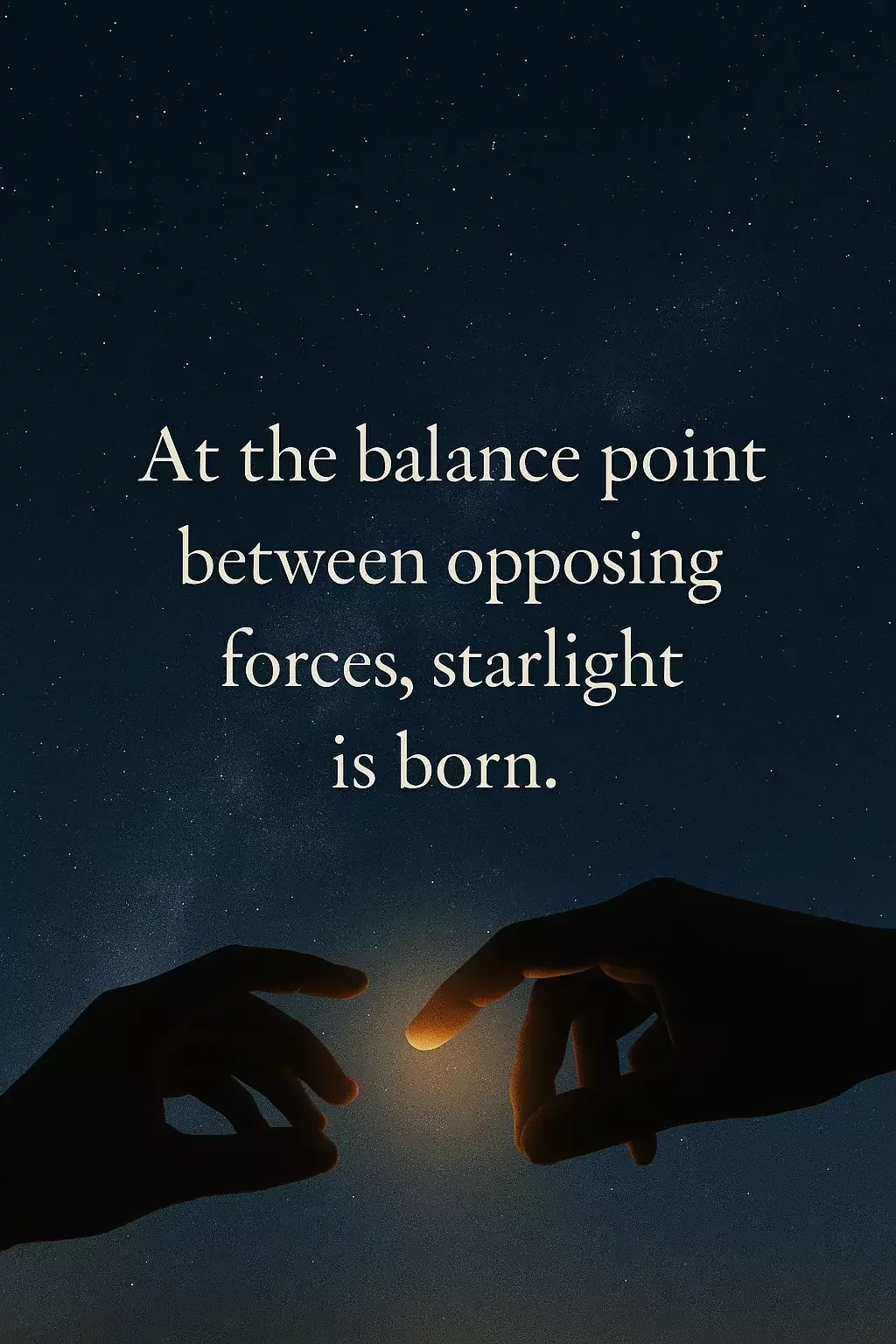
“Our partner’s triggers are the doorway to our own healing.”
Every relationship lives inside a tension — between closeness and space, stillness and movement, giving and receiving.
The Taoist principle of Yin and Yang captures this beautifully: two opposite yet complementary energies turning endlessly around one another. Yin is receptive, soft, inward. Yang is active, assertive, outward. The dance of these forces keeps the universe — and our relationships — alive.
When one dominates, harmony falters. When the two can meet without overpowering each other, balance — and growth — become possible.
The physicists describe a similar truth at the heart of every star.
2. Fusion and the Light That Holds Us
Deep within a star, two forces wrestle for balance: gravity pulls everything inward while nuclear fusion pushes outward. When the two find equilibrium, they produce light — radiant, life-giving, enduring.
According to NASA’s Imagine the Universe! programme, “Stars shine because of nuclear fusion — the combining of hydrogen nuclei into helium releases enormous energy as starlight.”
And as Stardate.org explains, “If gravity wins after fuel runs out, the core collapses into a black hole — an object so dense that not even light can escape.”
In cosmic and human terms alike, balance is everything. Too much pressure, and we implode; too little containment, and we burn out.
Relationships work much the same way. When love, conflict, fear, and longing push against each other in balance, they create radiance — the kind of connection that warms and nourishes. When the forces lose balance, connection collapses under its own weight.
As Dr John Gottman reminds us, “Conflict is not a sign of a broken relationship. It’s a sign that something is trying to grow.”
3. Why We Love Who We Love
Psychologically, we are often drawn to partners who feel familiar. In their tone, temperament, or emotional availability, we sense echoes of our earliest caregivers.
As Dr Gabor Maté writes, “We are attracted to the familiar not because it is good, but because it is familiar.” Our nervous systems seek completion — an unconscious attempt to heal old wounds through new love.
Glennon Doyle and Abby Wambach explored this beautifully in their podcast We Can Do Hard Things (episode “Why We Love Who We Love” with Dr Becky Kennedy). Dr Becky explains that we are meant to be triggered in love — not to repeat suffering, but to transform it:
“Our partner’s triggers are the doorway to our own healing.”
4. The Inner Child at Work
Inside every adult relationship, our inner children are still reaching out. They are the tender parts longing for the safety, attention, or soothing they missed.
When a partner withdraws, that child feels abandoned; when another criticises, shame rushes back. These reactions are not just about the present — they’re the echoes of the past.
As Bessel van der Kolk notes in The Body Keeps the Score, “The body remembers what the mind forgets.”
Our attachment histories live in our nervous systems, shaping how we love, argue, and repair.
Person-Centred Therapy reminds us that change happens through empathy, congruence, and unconditional positive regard. In relationship, these become the conditions of safety that allow us to work through the old patterns together rather than reenacting them alone.
5. Rupture and Repair
All relationships experience rupture — moments when connection breaks. The health of a partnership isn’t measured by whether rupture occurs, but by how we repair it.
Drs John and Julie Gottman found in decades of research that “Successful couples are not those who avoid conflict, but those who repair well after it.”
Repair means turning back toward each other with curiosity instead of defensiveness, softness instead of pride.
Rupture is the gravity pulling inward; repair is the fusion pushing outward. When both forces meet consciously, the energy released is intimacy itself — starlight born from pressure.
6. Starlight or Black Hole
The difference between collapse and illumination in a relationship often lies in willingness — both partners choosing to face the heat rather than flee it.
If we can stay steady enough to name our triggers, soothe one another, and rebuild safety, the tension becomes creation rather than destruction. Love becomes the alchemy that turns old pain into new light.
Perhaps this is what it means to “heal together”: to keep finding that balance point where gravity and fusion, fear and love, shadow and light coexist — and from that friction, to shine.
Further Reading
Astrophysics Sources
- NASA (2023). Imagine the Universe!: Why Do Stars Shine? https://imagine.gsfc.nasa.gov/science/objects/stars1.html
- Stardate.org (2022). Stellar-Mass Black Holes. https://blackholes.stardate.org/resources/article-stellar-mass-black-holes.html
- Advanced Science News (2024). What Is a Black Hole? https://www.advancedsciencenews.com/what-is-a-black-hole/
Psychological & Relational Sources
- Gottman, J. & Gottman, J. (2017). The Science of Trust. W.W. Norton.
- Van der Kolk, B. (2014). The Body Keeps the Score. Penguin.
- Maté, G. (2022). The Myth of Normal: Trauma, Illness and Healing in a Toxic Culture. Allen Lane.
- Rogers, C. (1961). On Becoming a Person. Houghton Mifflin.
- Doyle, G., Wambach, A., & Kennedy, B. (2023). We Can Do Hard Things [Podcast episode: “Why We Love Who We Love”].
About the Author
Martyn Blacklock is a counsellor, yoga teacher, and retreat facilitator who weaves psychology, embodiment, and nature connection to support people in rediscovering wholeness. He is the founder of Healing Together, a growing community dedicated to compassionate, integrated healing.