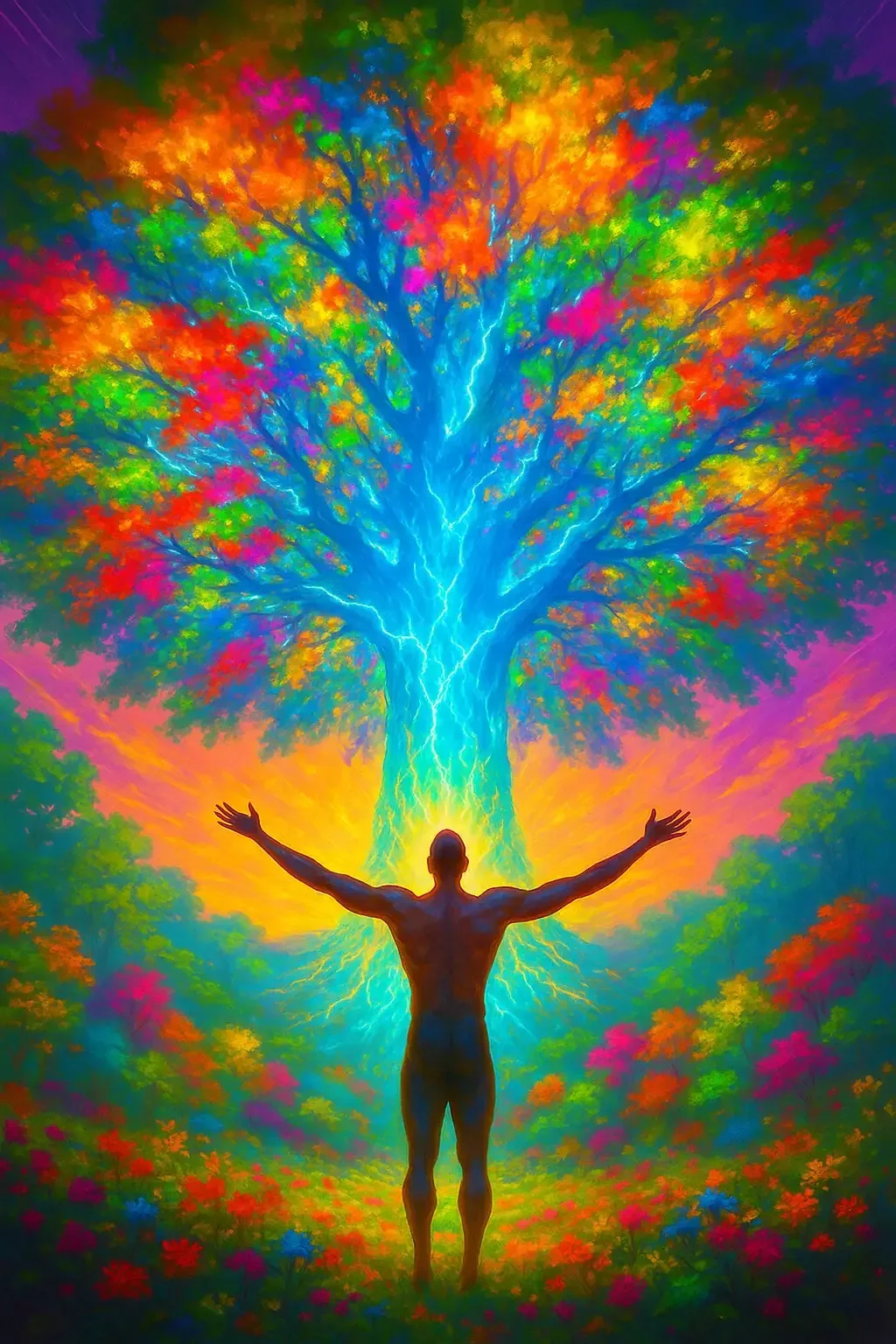
“Don’t turn away from what scares you — because you are missing out.”
by Martyn Blacklock | Healing Together
by Martyn Blacklock | Healing Together
1. Turning Away from What Scares Us
We live in a world that turns away from suffering. From illness, grief, trauma, difference — from anything that threatens our fragile sense of control. We look away because we are afraid it might be contagious, that somehow to touch the pain of another will expose our own. But what if turning away is exactly what keeps us ALL unwell?
In his book Black Magic, Chad Sanders writes about the hidden power that lives within those who have suffered. He calls it magic — “the resourcefulness, resilience, and radical empathy born from surviving what others could not.” Sanders’ words echo through every therapy session I’ve ever sat in. Those who have lived through pain see more, feel more, and hold a wisdom the world desperately needs. And yet, we often exile them. We call them too sensitive, too angry, too intense, too much. We label and distance instead of listening. It is safer to analyse someone’s difference than to meet it. But our fear of the suffering other is really our fear of ourselves — of the vulnerability, tenderness, and chaos we all carry just beneath the surface.
2. The Body as Witness
Working with people who live with CPTSD has shown me how the body remembers what the mind forgets.
Hypervigilance, exhaustion, the constant search for safety — these are not malfunctions, but adaptations; the body’s sacred intelligence at work.
My most traumatised clients are also my greatest teachers. They have taught me more about compassion, patience, and truth than any training ever could. They show me how survival is not a story of weakness, but of the body’s genius.
Dr Bessel van der Kolk reminds us that “the body keeps the score,” and Edith Eger, survivor of Auschwitz, deepens this truth:
“We can’t heal what we don’t feel.”
To feel — even when it hurts — is an act of courage. Our culture equates feeling with fragility, but in truth, sensitivity is the most advanced form of awareness we possess. Those who feel deeply are not broken; they are tuned in.
3. Anger — The Defender of Sensitivity
Anger has a bad reputation. It’s seen as dangerous, destructive, unspiritual. But anger is not the opposite of love; it is love’s bodyguard.
As Brené Brown writes,
“Anger is a catalyst. Holding onto it will make us exhausted and sick, but using it as a catalyst for change can transform our lives.”
Anger is how the body defends what it loves — our boundaries, our truth, our self-respect. Beneath anger lives something softer: grief, fear, shame, longing.
For many men of the baby-boomer generation — the ones I wrote about in The Quiet Ache — anger was the only acceptable language for emotion. Tenderness was shamed out of them, sadness ignored, vulnerability ridiculed. Anger was what was left.
But anger, when met with curiosity instead of condemnation, becomes a teacher. It asks: What am I protecting? What need has gone unseen for too long?
4. Trans-generational Fire: Amram’s Story
I’ve witnessed this lesson most vividly through my partner, Amram. His grandmother fled war in Europe as a refugee during World War II — carrying the fear, resilience, and vigilance of that generation deep within her cells. That trauma echoes in him still — not as pathology, but as sensitivity, intuition, and a fierce relationship with truth. Amram won’t suffer fools gladly. When he senses injustice, he speaks. When someone hides behind politeness instead of integrity, he refuses to collude. It’s not aggression; it’s awareness. His anger says, “I will not let you harm yourself or others through unconsciousness.”
Loving him has invited me to meet my own shadow. His clarity and courage have held up a mirror to the parts of me that once preferred harmony over honesty. Through him I’ve learned that real compassion isn’t always gentle — sometimes it roars. And that self-respect, expressed through healthy anger, is a profound act of love. This relationship has changed my work. It’s made me braver in the therapy room, less afraid of intensity, more able to hold the raw and the real. It has taught me that safety doesn’t mean silence; it means truth, held with care.
5. The Courage Not to Look Away
I was recently invited to contribute to a BBC film about trans lives — a project that explored the courage it takes simply to be oneself in a world that prefers simplicity to truth. Many trans people live under the constant gaze of a society that fears difference. Their existence alone challenges binary thinking — and for that, they are often met with projection, misunderstanding, or outright hostility. In the interview, I spoke about how therapy must become a space of safety without assumption. That each person’s journey with gender, neurodivergence, or trauma is unique — and that identity exploration is not pathology, but self-reclamation.
Our discomfort with transness is the same discomfort we have with grief, trauma, or mental illness: it’s our collective fear of what we cannot control.
But those who live courageously in their truth — who refuse to contort themselves to fit society’s limits — are our teachers. They show us what integrity looks like when it costs something.
As Edith Eger says in The Gift,
“When we judge others, we create distance; when we choose curiosity, we create connection.”
6. The Magic We Miss
Black Magic is not about sorcery; it’s about transformation — the turning of pain into power, oppression into wisdom, and fear into empathy.
Chad Sanders writes,
“Magic is what we make from what tried to destroy us.”
That line captures everything I’ve learned from my clients, my partner, and my own healing: that what is feared holds the medicine.
The people who live closest to suffering — those who have faced trauma, discrimination, or displacement — often carry the deepest knowledge of how to live with compassion.
They remind us of what we’ve forgotten: that sensitivity is not weakness, and that tenderness is not fragility but strength.
7. A Different Kind of Light
We are being called to reclaim our sensitivity — to choose to be tuned in again.
To stop numbing, judging, and turning away. To sit beside pain long enough for it to reveal what it’s trying to teach. There is a kind of light that only those who have suffered can hold — a steady, honest light that doesn’t blind or burn. It’s the light of awareness, of humility, of having touched darkness and chosen compassion anyway.
So don’t turn away from what scares you, or who scares you — because you are missing out. There is magic in those who have survived what we cannot imagine. If we can learn to sit beside suffering instead of fearing it, we may yet remember how to be human again.
Further Reading
Sanders, C. (2021). Black Magic: What Black Leaders Learned from Trauma and Triumph. Gallery Books.
Eger, E. (2017). The Choice. Rider Books.
Eger, E. (2020). The Gift: 12 Lessons to Save Your Life. Rider Books.
Brown, B. (2021). Atlas of the Heart. Vermilion.
van der Kolk, B. (2014). The Body Keeps the Score. Penguin.
Porges, S. (2011). The Polyvagal Theory. Norton.
BBC News (2024). Inside the Lives of Trans People in Britain. https://www.bbc.co.uk/news/articles/c2leglpy79eo